Most brands targeting students are reaching the wrong people, in the wrong places, at the wrong time. Unifresher Intelligence changes that - city by city, university by university.
We've run 410 student campaigns. These are the mistakes we see every year, and the ones that are costing brands the most.
Edinburgh students arrive Sep 5. Bath arrives Oct 5. A 30-day window - and most brands pick one date somewhere in the middle. They miss the earliest arrivals entirely and are late for others.
Students don't live everywhere in a city - they cluster in specific postcodes. NG7 in Nottingham, LS6 in Leeds, B29 in Birmingham. City-level targeting burns the majority of impressions on non-students.
A brand with 400 locations can't run a student campaign across all of them. But without data, they either go national (wasteful) or guess (worse). Most have no idea which of their stores are actually near student infrastructure.
A first-year in halls and a third-year in an HMO are completely different customers. Different locations, different products they need, different times of year they're receptive. Blanket "student" targeting treats them as one.
The best targeting in the world falls flat if the offer, message, or channel is wrong. What do students in your category actually care about? What makes them switch? Most brands are guessing - because no one has asked.
After the campaign, there's a reach number and a CPM. But did it reach the right students? Did it run in the right window? What would have made it work harder? Most brands repeat the same campaign year after year without ever knowing.
The platform does the analysis. You get a campaign brief built around one principle: the right student, right time, right message - telling your team or agency exactly where to spend, when, and why.
Upload your store locations, or define your target audience - year group, accommodation type, subject area. The platform works from your reality, not a generic template.
The platform cross-references your inputs against our proprietary student data - halls, HMO zones, campuses, move-in dates, competitor positions - and surfaces every opportunity and risk.
Export a targeting brief with prioritised locations or per-city schedules, postcode lists, and timing windows. Take it to your agency, or activate yourself - the insight is yours to use across any channel.
A campaign brief that tells you which locations or cities to prioritise, which postcodes to target, and when to go live in each market - replacing weeks of manual research and guesswork with a decision you can defend. The result: your student budget stretches further, reaching more of the right students for every pound spent.

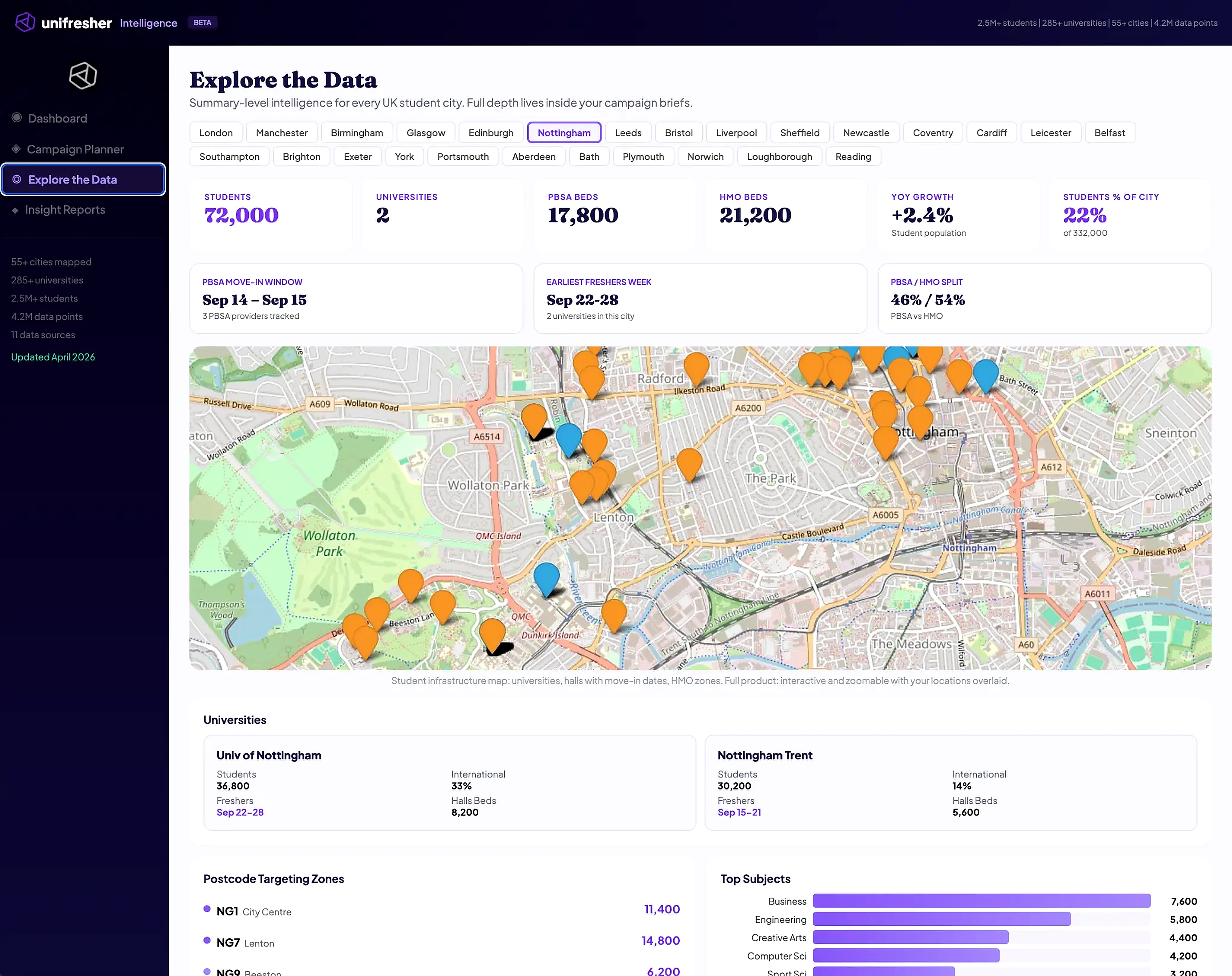
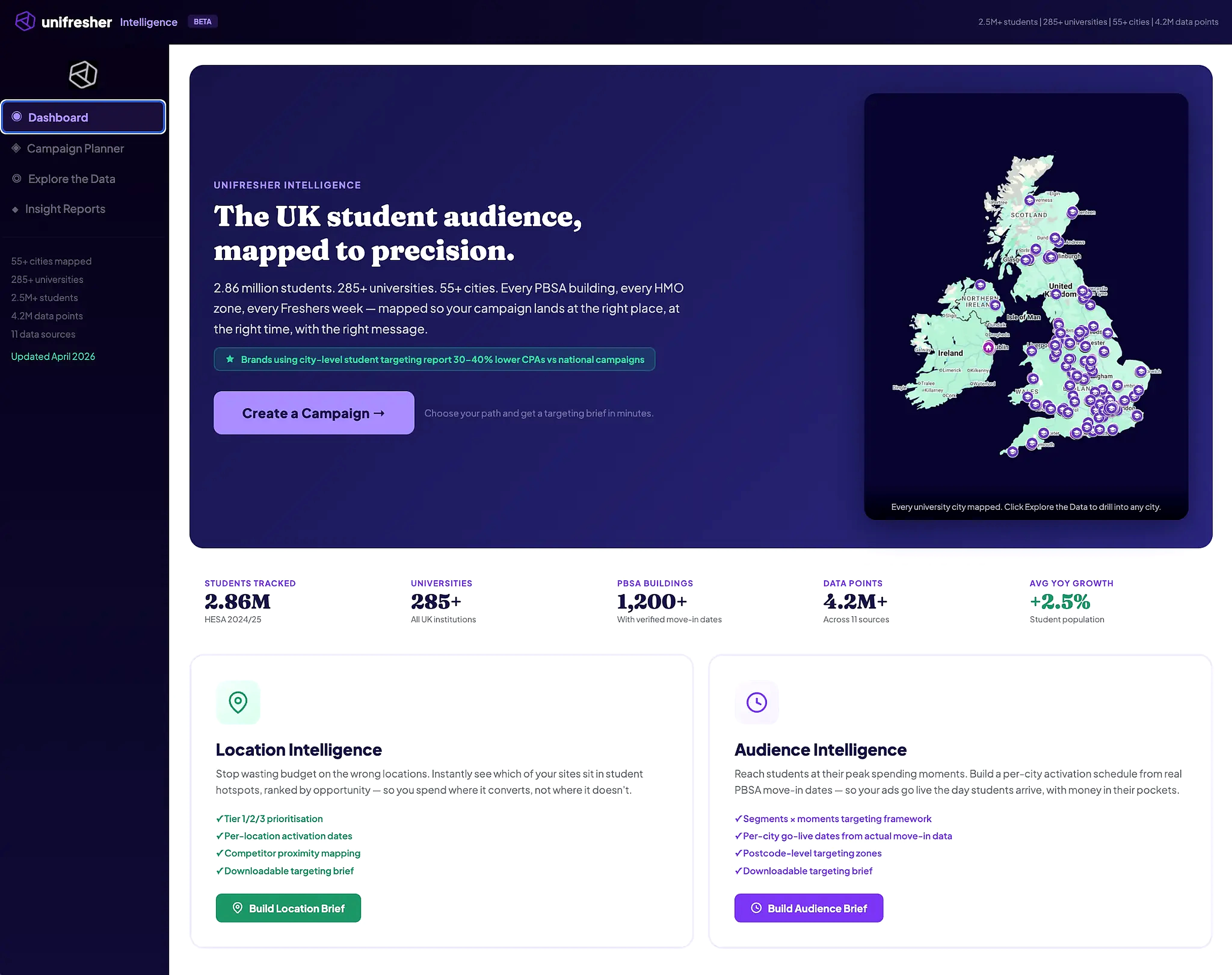
Your starting point before any campaign. A real-time read on the UK student market: population by city, year-on-year growth, PBSA and HMO bed counts, and the timing signals that set the context for every spend decision you'll make.

Select any of 55+ UK student cities and instantly see the full picture: total students, number of universities, PBSA and HMO bed counts, year-on-year growth, PBSA move-in windows, and a street-level map of every hall and campus. The postcode targeting zones and top subjects are included - so you know exactly where students live and what they study.

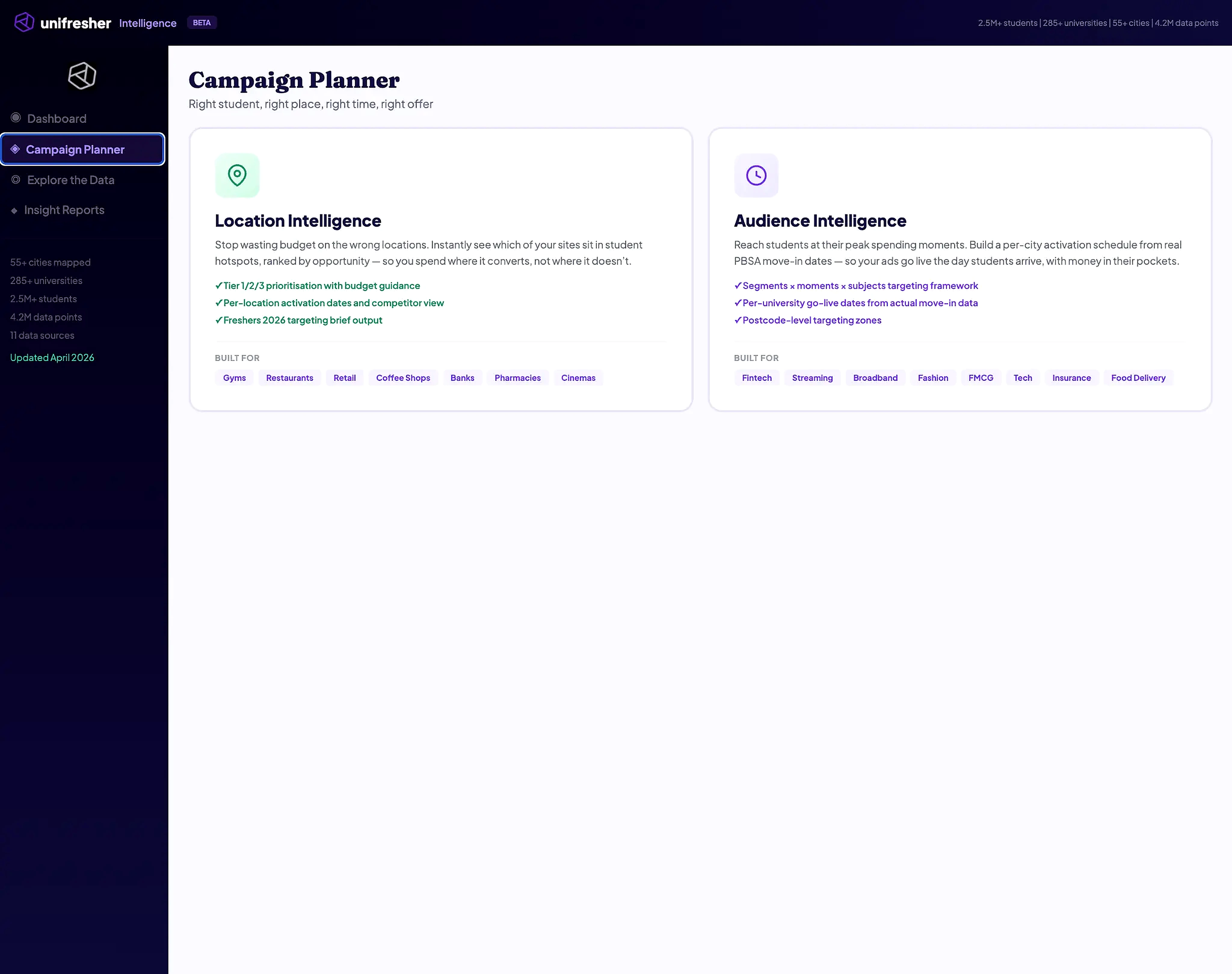
Choose your path: Location Intelligence if you have physical stores, Audience Intelligence if you're a digital-first brand. The planner routes you into the right flow for your brand and starts building your brief from there.

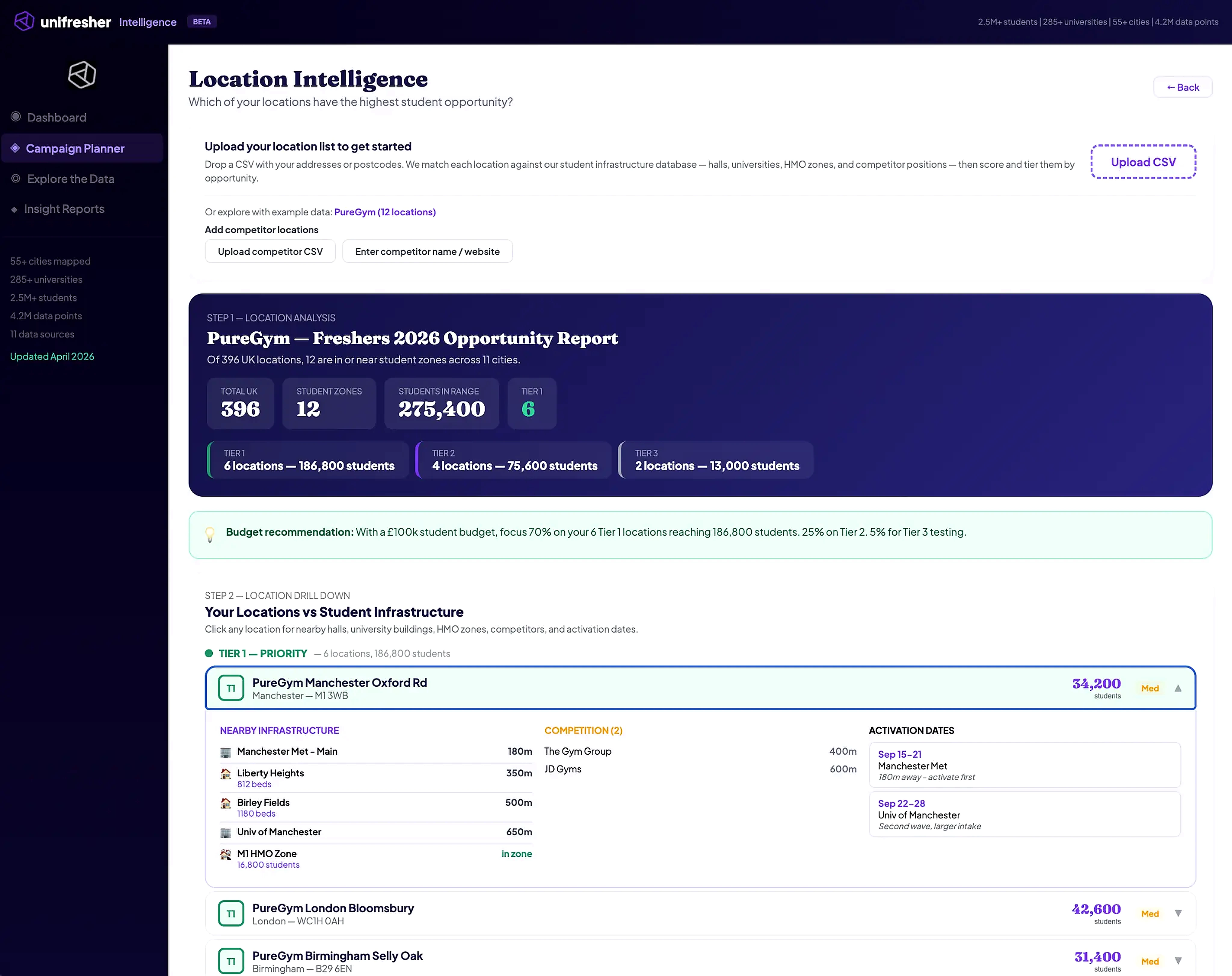
Upload your location list. The platform scores every store against nearby student infrastructure - halls with bed counts and move-in dates, HMO zones, campus buildings, competitor positions. The result is a tiered brief: Tier 1 stores get the budget, Tier 2 get tested, Tier 3 sit out. No more guessing which sites are worth activating for students.

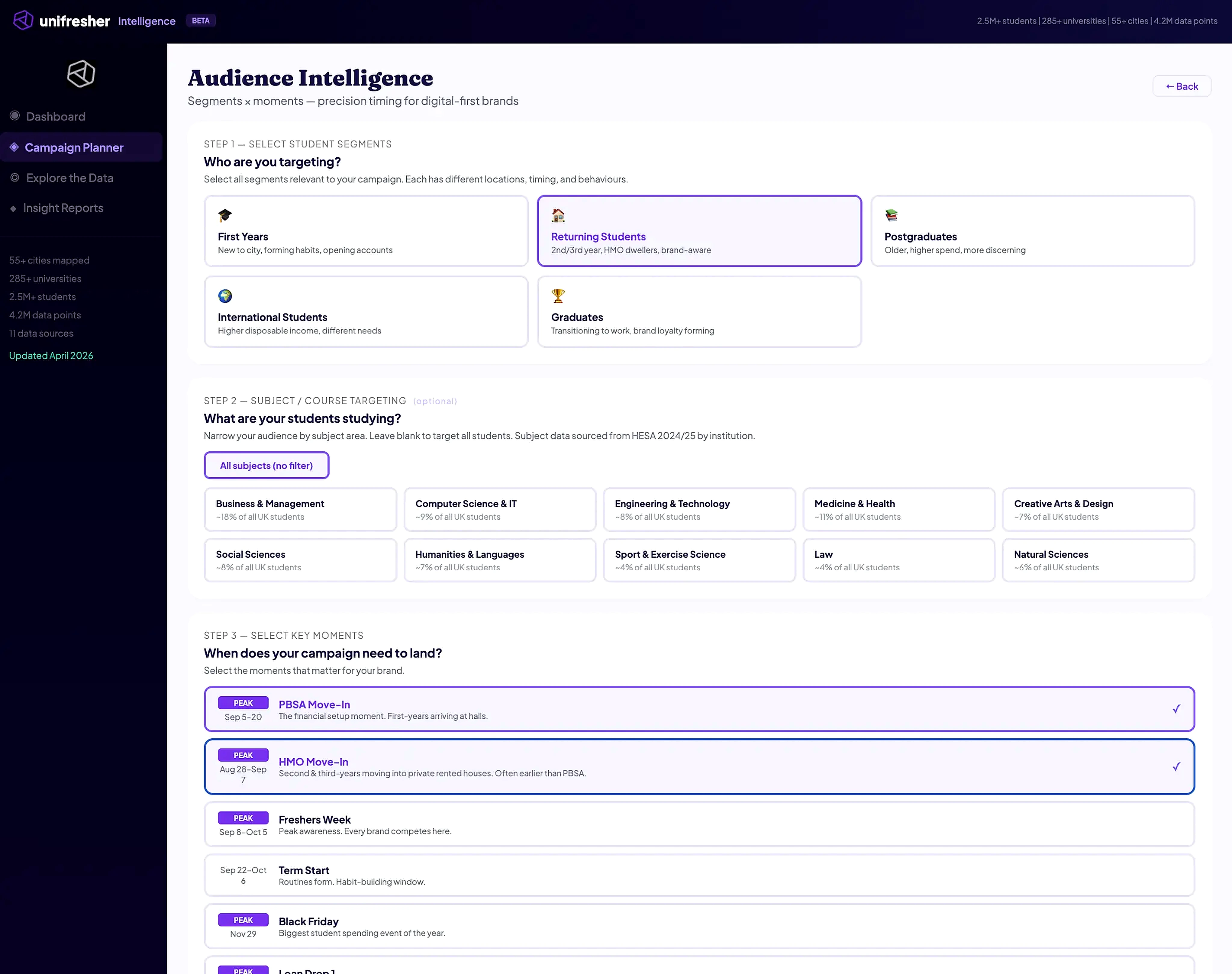
Define your segment and get a city-by-city go-live schedule built from actual PBSA move-in data - not Freshers week estimates. Each city gets its own launch date, audience size, postcode list, and growth rate. The opposite of one national launch date.*
* Sample data shown. Brand examples are illustrative only.

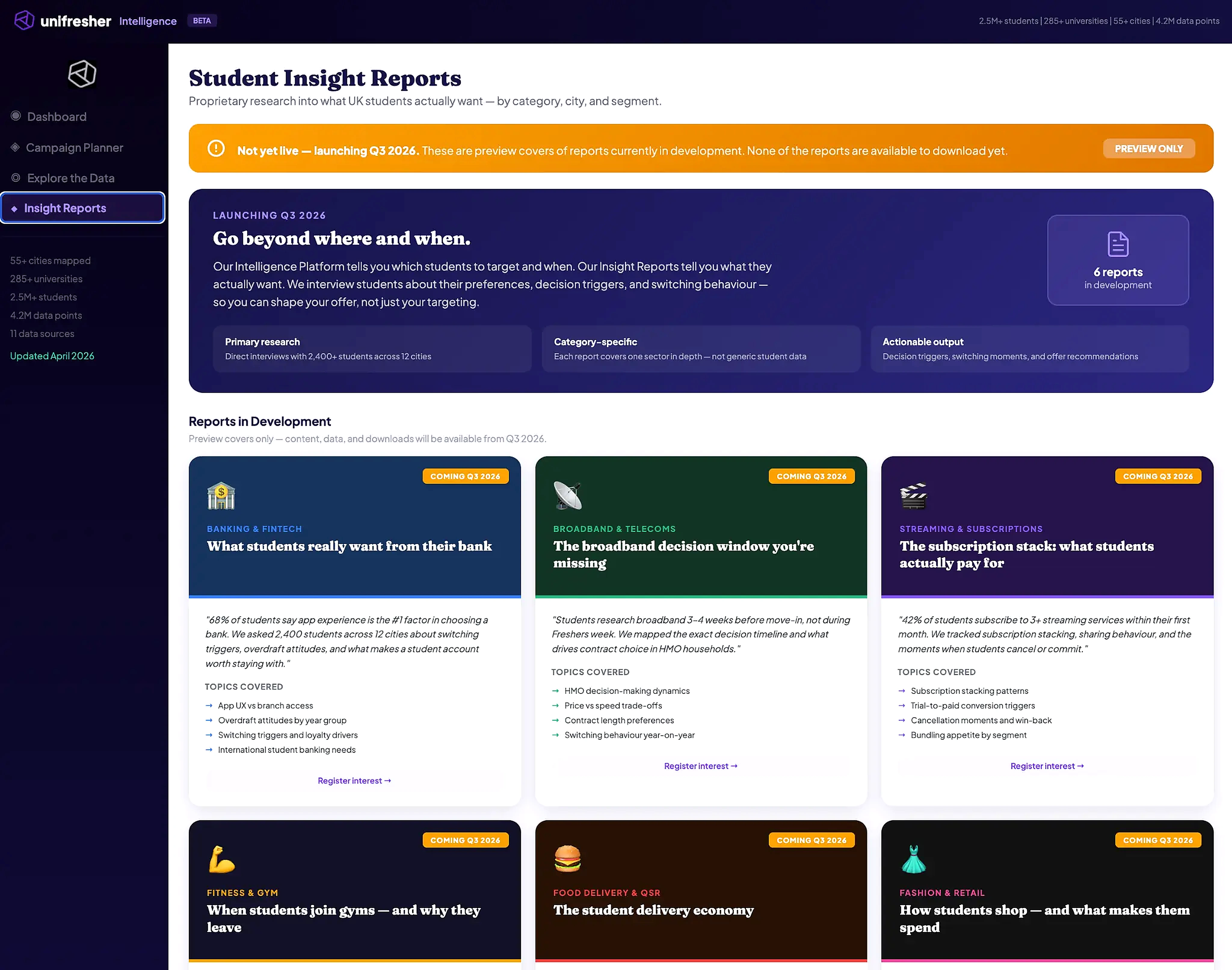
The platform tells you which students to target and when. Insight Reports tell you what they actually want. Based on direct interviews with 2,400+ students across 12 cities, each report covers one sector in depth - decision triggers, switching behaviour, and offer recommendations. Launching Q3 2026.
Four scenarios - one for brands with physical locations, one for digital-first brands, one hybrid, and one for QSR and restaurant chains. Each one shows the decisions that are currently costing budget, and what changes with Unifresher Intelligence.
A broadband provider wants to sign up students moving into their first HMO. Budget: £200k. Target: students who need broadband for the first time - first-years leaving halls for their first shared house.
First-years in halls don't need broadband - it's included. Only second-years moving into HMOs need a contract. Without this filter, roughly 70% of impressions reach students who can't convert.
Second-years move into HMOs in late August - weeks before term starts. Broadband decisions happen during move-in, not during Freshers. A September launch is already too late for most of the audience.
HMO zones cluster on specific streets: NG7 in Nottingham, S6 in Sheffield, B29 in Birmingham. City-level geo or interest-based targeting reaches far more non-students than students in HMOs - and misses the ones who are actively moving in right now.
Set audience to Year 2, HMO accommodation. Platform surfaces 340,000 second-year students moving into HMOs for the first time across 25 cities - the audience that can actually convert, not a broad student sweep.
Platform outputs street-level targeting zones: NG7 Lenton (14,800 students), LS6 Headingley (11,200), B29 Selly Oak (9,400). These are ready for campaign setup - not broad city codes.
Manchester go-live Aug 26 · Leeds Sep 2 · Nottingham Sep 8 · Bath Sep 22. Each city activates two days before students move in - when they're choosing providers, not after contracts are signed.
Audience definition, postcode lists, per-city go-live dates, and audience sizes - exported as a brief your agency can execute across any channel.
Also applies to: Any utility or service targeting second-year students at move-in
A gym chain with 400 UK locations wants to acquire student members during Freshers. Budget: £150k. They want to reach students near their gyms - but don't know which locations are actually worth activating.
Without data, the options are: go national (expensive, wasteful) or choose cities by gut feel. Most brands either overspend in cities where they've already captured a large share of the student market, or underspend in cities where they're barely present despite large student populations nearby.
A national September 15 launch ignores the fact that Edinburgh universities start Sep 5, Leeds Sep 10, Bath Oct 3. Locations near early-starting universities miss the first two weeks entirely.
The campaign goes live without knowing that a competitor gym sits 300m from the campus entrance at two of their highest-priority locations. Budget spent in direct competition for the same students.
Upload the full 400-location list. Platform matches each one against nearby halls (with bed counts and distances), HMO zones, campus buildings, and competitor positions. Every store gets a student opportunity score.
Platform also surfaces the student market picture per city: how many students are there, how many gyms are competing for them, and whether the market is already saturated or under-served. A city where you have a location but already hold a large share may be less valuable than a city where you're present but barely known.
12 locations in genuine student zones. 6 are Tier 1 - high bed counts, close proximity, no major competitor blocking. 4 are Tier 2 - worth testing. 2 are Tier 3 - marginal. Budget goes to Tier 1.
Manchester Oxford Rd: activate Sep 15 (Manchester Met Freshers). Edinburgh Nicholson St: activate Sep 5 (two weeks earlier). Bath: activate Oct 3. Each location gets its own launch window based on the nearest university calendar.
Platform surfaces that The Gym Group sits 400m from your Manchester location and JD Gyms is 300m from your Leeds site. You know this before you spend - and can adjust messaging, offer, or channel accordingly.
Also applies to: Any brand with a physical estate wanting to identify student-zone locations
A digital bank wants to acquire first-year student accounts. Budget: £300k. They're running well in some cities, invisible in others - but don't know which is which, or why.
By the time the campaign goes live, students in Edinburgh and Glasgow have already been at university for two weeks. Their banking decisions were made during move-in - before the campaign started.
Edinburgh, Glasgow, and Manchester have very different first-year PBSA populations - but the campaign treats them equally. Budget is spread evenly across all cities, with no weighting for where the highest-value audience actually is.
The highest-value moment is the first weeks of university, when students open their first adult bank account. But the campaign reaches all students equally - including those already locked into a 3-year banking relationship.
Filter to Year 1, PBSA accommodation. Platform surfaces 192,300 first-year students in halls across 12 priority cities - the moment of highest receptivity for a bank account switch.
Edinburgh Sep 3 · Manchester Sep 10 · Nottingham Sep 12 · Birmingham Sep 14 · Bath Oct 5. Campaign activates in each city just as students physically arrive - not two weeks later when they've already sorted their finances.
The platform surfaces city-level opportunity data: student population size, PBSA move-in windows, and campaign timing by university. The output shows which cities have the highest student concentration and when to activate - so budget goes where it will work hardest.
Per-city activation dates, PBSA postcode lists, audience sizes, and growth trends. Ready to take to your media agency or run directly on paid social.
Also applies to: Any financial brand targeting first-year account-opening
A QSR restaurant chain with 180 UK locations wants to drive student footfall during Freshers. Budget: £120k. They want to reach students near their restaurants - but have no visibility on which sites are actually in student zones.
Without location intelligence, the brand either runs a broad national campaign (expensive, wasteful) or selects cities based on gut feel and historical sales data. Sites near campuses get the same budget as sites in retail parks with no student footfall.
A Sep 15 national launch misses Edinburgh (students arrive Sep 12), is too early for Bath (students arrive Oct 3), and ignores the fact that Freshers spend peaks in the first 48 hours after move-in - not during Welcome Week.
City-level targeting of 18-24 year olds reaches a broad demographic - many of whom are not students. The students most likely to visit a QSR in the first week of university are first-years in halls, hungry, unfamiliar with the area, and highly receptive. That specific group is never isolated.
Upload the full 180-location list. Platform matches each against nearby halls (bed counts, distances), campus buildings, and competitor QSR positions. Every site gets a student opportunity score - Tier 1, 2, or 3.
22 locations sit within genuine student zones. 9 are Tier 1 - within 400m of a major hall cluster, no dominant competitor blocking. Budget concentrates here. The other 158 sites don't get student-specific spend.
Edinburgh: activate Sep 12 · Manchester: Sep 15 · Nottingham: Sep 14 · Bath: Oct 3. Each site goes live two days before students move in nearby - catching the first-week discovery moment, not missing it.
Platform outputs postcode-level targeting zones around each Tier 1 site - the streets where first-year students actually live. Audience filtered to Year 1, PBSA accommodation. Brief ready for paid social, OOH, or delivery platform targeting.
Also applies to: Any QSR, coffee chain, or food brand with a physical estate wanting to identify and prioritise student-zone locations
Want to see this for your brand?
We'll run a live demo using your locations, audience, or an existing campaign - 20 minutes.
Drag the slider to your annual student marketing spend. We'll show you where budget typically leaks - and how much Unifresher Intelligence can recover.
Whether you have stores on the ground or serve the country digitally, the platform starts from your reality - not a generic template.
Gyms, restaurants, retail, banks, coffee shops. Upload your location list and get a student opportunity score for every store - plus per-store activation dates and competitor visibility.
A gym chain: 396 locations analysed. 12 in student zones. 6 Tier 1, covering 186,800 students. Per-store activation schedule and targeting brief ready to action.
Fintech, streaming, broadband, tech, fashion. Define your audience and get a per-city activation schedule - each city with its own go-live date, audience size, and postcode list.
A broadband provider targeting second-year students moving into HMOs: 14 cities, each with its own go-live date tied to HMO move-in. Manchester Aug 26 · Leeds Sep 1 · Nottingham Sep 8 · Bath Sep 20. Audience filtered to Year 2, HMO accommodation only. 340,000 in-market students vs 1.2M broad student sweep.
It's not just city by city. It's university by university - and the platform tracks every one.
Four years in the making. Assembled from dozens of public and private sources, structured, verified, and maintained so you don't have to.
Enrolments by subject, year group, mode of study and domicile - per university and city, with year-on-year growth trends going back multiple years.
PBSA locations with verified bed counts, move-in dates per provider, and HMO density zones mapped to street level - not just a postcode radius.
Term dates, Freshers weeks, exam periods, loan drop dates, move-in windows, and campaign-relevant moments - per university, updated every term automatically.
We verify actual PBSA arrival dates from the major operators. Students are making purchase decisions before Freshers week starts. Brands that wait until then have already missed the moment.
We match each brand location against nearby student infrastructure and score it for genuine opportunity. The output is a per-store brief - not a city-level estimate that still leaves the hard call to you.
First-years in PBSA halls, second-years in HMOs, postgraduates, international students - each segment has different locations, different timing, and different conversion triggers. The platform lets you target the exact segment that can actually buy from you, not just "students" as a broad category.
What does a well-targeted student campaign actually deliver? We know - because we've run them. Your campaign gets benchmarked against hundreds of comparable student campaigns, so you can see whether your results are good or just average.
Launching Q3 2026: first-party surveys across 10,000+ students. What do students in your category actually care about? What makes them switch? What offer lands? Data you can use to sharpen the message, not just the targeting.
The targeting brief is yours to use across any channel - Meta, TikTok, Google, OOH, or your agency's DSP. And if you want to activate it on Unifresher's own student platform (unifresher.co.uk - 500,000+ students per month across 25 UK cities), that option is there too.
Unifresher has published localised student content across 25 UK cities for over 10 years. We've run more than 2,000 student campaigns across that time - including 410 in 2025 alone - for brands including Taco Bell, Deliveroo, Vue, Boots, and Aldi.
Every year, we watched brand budgets being spent inefficiently - wrong timing, wrong postcodes, wrong audience split. We built the Intelligence platform because we wanted to change that for our own clients. Now we're making it available to any brand targeting UK students, across any channel.
The platform runs on data that took years to assemble. The campaign intelligence layer is built on what we've actually seen work - and what we've seen fail - across a decade of student marketing.
Location intelligence: which restaurants are near campuses, which aren't, and when to run student promotions per site.
Audience intelligence: first-year PBSA targeting at the account-opening moment, staggered by city move-in date.
Location scoring across full estate: which gyms to activate, when, and with what competitive context.
National digital campaigns staggered city by city - replacing single-date national launches with precision timing.
Second-year HMO move-in targeting: the exact streets, the right window, before contracts get signed elsewhere.
We're onboarding a small number of brands and agencies ahead of public launch. Early access means your feedback shapes the platform - and your pricing is locked for two years.
We'll run the platform live using your brand's context - locations, audience, or an existing campaign. No slides. No decks. Just the platform.
No commitment. We'll be in touch within 48 hours to arrange a time.